
Architecture Overview
A2AL is a decentralized address resolution protocol. Its sole function is to map a cryptographic identity (AID) to current network endpoints, so that any two agents can establish a direct encrypted connection without prior knowledge of each other’s IP address or network location.
A2AL does not route application data, operate as a message relay, or manage application-level state. Once a connection is established, the protocol steps aside. All data flows directly between agents.
Two Modes
Section titled “Two Modes”Daemon Mode (recommended for most use cases)
Section titled “Daemon Mode (recommended for most use cases)”Run a2ald as a background service. Your application integrates via:
- MCP — AI tools call networking tools directly (zero code)
- REST API — HTTP calls from any language (
localhost:2121)
This mode requires no Go knowledge and works with any language or framework.
Library Mode (Go only)
Section titled “Library Mode (Go only)”Import github.com/a2al/a2al directly into your Go program. Full control, no separate process. The primary entry point is the host package.
Module Map
Section titled “Module Map”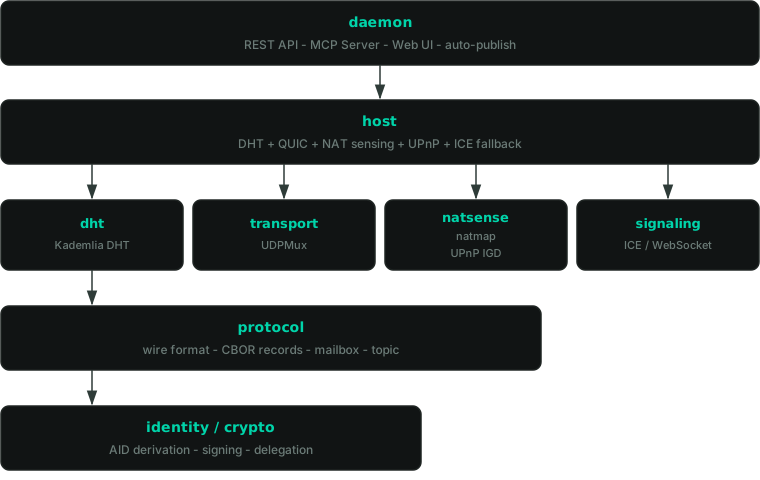
Dependencies flow downward. daemon depends on host; host depends on dht, transport, natsense, and protocol; all depend on identity/crypto at the bottom.
Module Descriptions
Section titled “Module Descriptions”| Module | Role |
|---|---|
identity / crypto | Key generation, AID derivation, sign/verify, delegation model. |
protocol | All on-wire CBOR data structures: endpoint records, mailbox messages, topic records. |
transport | UDP socket management. UDPMux demultiplexes a single UDP socket between DHT and QUIC. |
dht | Kademlia-style DHT: FIND_NODE, FIND_VALUE, STORE, K-Bucket routing. |
natsense / natmap | Infers NAT type from peer reflection; handles UPnP port mapping. |
signaling | WebSocket ICE trickle signaling, used as fallback when direct QUIC fails. |
host | Primary Go integration layer. Composes all lower layers into a single runtime. |
daemon | The a2ald binary. Wraps host with REST API, MCP server, Web UI, and auto-publish. |
Connection Establishment
Section titled “Connection Establishment”Two paths exist for establishing a QUIC connection:
Direct path (primary): Dials all endpoints from the target’s record concurrently. The first successful QUIC handshake wins. Both sides perform mutual TLS with certificates derived from their Ed25519 keys.
ICE path (fallback): When all direct dials fail and the endpoint record carries a signaling URL, both peers exchange ICE candidates via WebSocket and establish a peer-to-peer UDP path. QUIC then runs over that path.
Choose Your Integration Path
Section titled “Choose Your Integration Path”| Path | Best for | Getting started |
|---|---|---|
| MCP | AI coding tools (Claude, Cursor, Windsurf) | MCP Setup |
| REST API | Any language, fastest to start | REST Quickstart |
| Go SDK | Go programs, maximum control | Go SDK |
| Python | Python agents via sidecar | Python Sidecar |
Relationship to Other Protocols
Section titled “Relationship to Other Protocols”| Protocol | Relationship |
|---|---|
| MCP | A2AL runs as an MCP server, exposing networking as tool calls. MCP defines the calling convention; A2AL provides the network. |
| A2A | A2AL provides the discovery and connectivity layer that A2A assumes but does not define. A2A messages flow over A2AL connections. |
| QUIC | A2AL uses QUIC for all agent-to-agent connections: TLS 1.3, stream multiplexing, connection migration. |
| ICE/STUN | Used in the ICE fallback path. A2AL does not define its own NAT traversal protocol. |